how to make long lasting crispy fried tempeh | illustration photo: Gemini AI
Brilio.net – Fried tempeh is a side dish that you can almost never go wrong with, it’s cheap, easy to make, and goes well with anything. But there is a big difference between fried tempeh that is just cooked and fried tempeh that is really tasty and penetrates deep inside. The second is what makes it difficult to stop eating.
So far, the two common ways to get seasoned and crispy fried tempeh are to first cover it in a spice solution or coat it with wheat flour. Both work, but both require extra steps and take more time. It turns out there is a faster trick and the results are delicious which was shared by YouTube user Acil Jawi. The key is in one simple step before the tempeh goes into the pan.
Why is Regular Fried Tempeh Often Less Seasoned?
Tempe has a dense and tight structure, its surface does not easily absorb seasoning liquid from the outside. If fried directly without pretreatment, the spices will only stick to the surface and will easily fall off when exposed to hot oil. The result is that the tempeh is cooked but the taste is flat, there are no savory layers that can be felt inside.
Stirring does solve this problem, but it takes a minimum of 15–30 minutes for the flavors to really set in. The flour coating creates a crunchy texture but sometimes it actually masks the taste of the tempeh itself. The trick of slicing the surface of the tempeh before smearing it with spices is a more efficient middle solution, the spices have a direct route to the inside without taking a long time.
The Role of Coriander in Fried Tempe
Many people think that coriander is just a complementary spice that can be reduced according to taste. But in a fried tempeh recipe without frying like this, coriander actually plays a more important role than it seems.
Coriander contains the compounds linalool and pinene which produce a distinctive warm aroma, this aroma is what makes fried tempeh with spices taste different from those only served with salt and onions. Apart from aroma, coriander also helps create a thin brown layer on the surface of the tempeh when fried, which contributes to a crispier texture. It’s no surprise that Acil Jawi emphasized, “If you want it to be delicious, you have to use a lot of coriander, OK?”
How to Make Crispy, Long-Lasting Fried Tempeh Without Flour and Sauce
Material:
– 1 board of tempeh (around 300–400 gr)
– 3 cloves of garlic
– 1–2 tsp coriander (to taste, the more the better)
– Salt to taste
– A little water
– Enough cooking oil
Step 1 — Cut and slice the tempeh
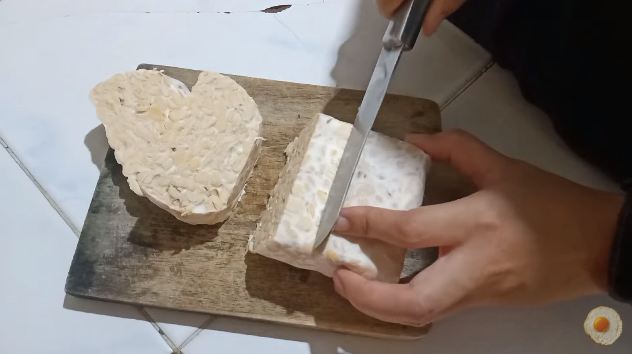
photo: YouTube/Emergency Jawi
Cut tempeh according to taste.
“If I cut it with the thickness of 1 knuckle,” that’s how Acil Jawi cuts it.
Thickness is important — too thin makes the tempeh burn easily before the flavors are absorbed, too thick makes the inside less cooked.
Once cut, take each piece and make shallow cuts on both sides of the surface using the tip of a knife. This incision opens a path for the spice solution to penetrate the tempeh more evenly.
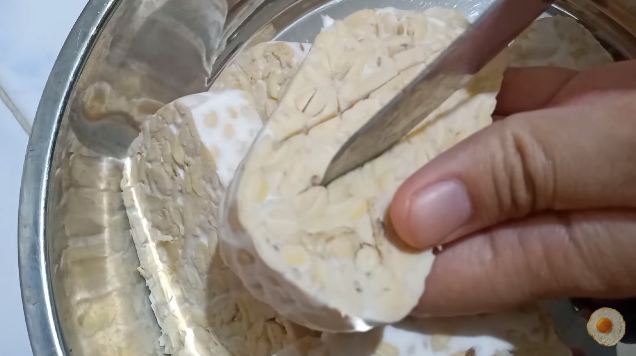
photo: YouTube/Emergency Jawi
Step 2 — Make a spice solution
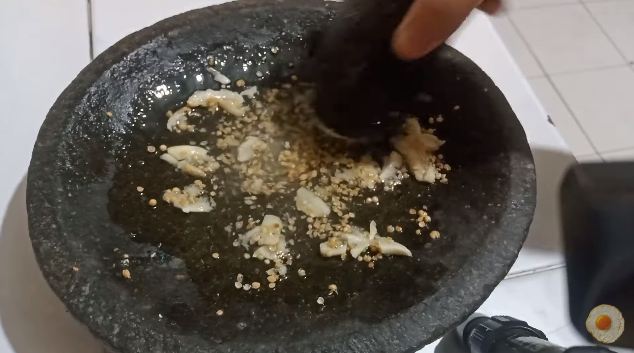
photo: YouTube/Emergency Jawi
Put the garlic, coriander and salt into the mortar. Pulse until all ingredients are smooth and mixed. Add a little water then stir well until it becomes a spice solution that is not too thick and not too runny.
Put all the tempeh pieces into the spice solution, turning each piece so that the entire surface is evenly exposed to the spices, including the incisions that were made previously.
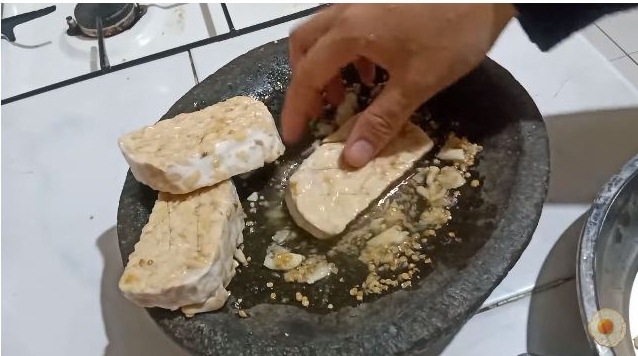
photo: YouTube/Emergency Jawi
Step 3 — Fry over medium heat
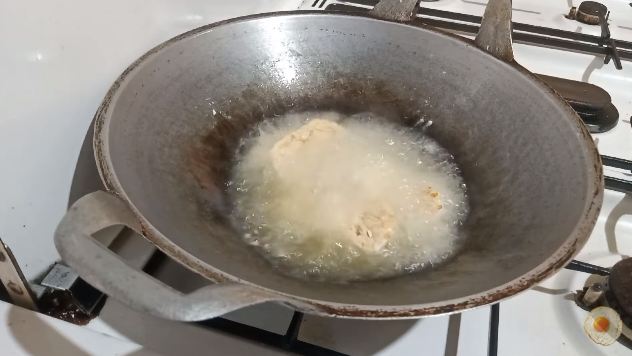
photo: YouTube/Emergency Jawi
Heat enough cooking oil, the tempeh should be partially submerged so that it cooks evenly. Put tempeh into hot oil and fry over medium heat. Medium heat is the key to getting a long-lasting crispy texture; If the fire is too big, the surface will burn quickly but the inside will not be dry, while if the fire is too small, the tempeh will absorb too much oil.
Turn the tempeh back and forth during the frying process so that it cooks evenly. Remove when the entire surface is brownish yellow, drain in a colander until the oil has completely drained before transferring to a serving plate.
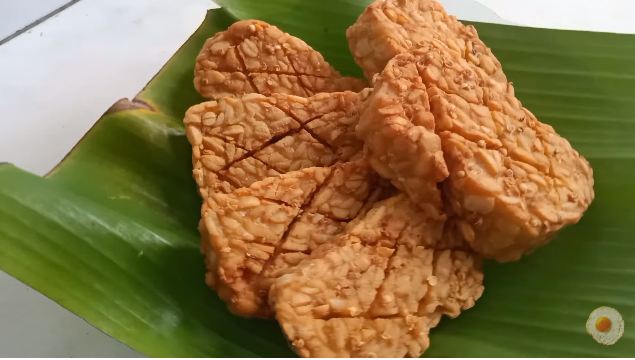
photo: YouTube/Emergency Jawi
Why does this fried tempeh last so long?
The claim of “long lasting” on fried tempeh is not just about seasoning. There are several technical factors that determine how long fried tempeh can remain crispy and not go soft quickly.
Factors that make fried tempeh more durable:
1. Low water content: tempeh that is fried until completely dry over medium heat has a lower water content, so it doesn’t get soggy easily even if it’s stored for several hours
2. No flour coating: flour that absorbs excess oil actually softens faster because the oil trapped in the flour layer will soften the texture over time
3. Drain perfectly: the oil remaining on the surface of the tempeh is the main cause of the texture becoming soft quickly, that’s why the draining process should not be rushed
Tempeh fried this way can stay crispy for up to 4-6 hours at room temperature. If you want to store it longer as side dish stock, store it in a closed container without airtight plastic so that water vapor is not trapped inside.
Tips for Storing Fried Tempeh to Keep It Crispy
1. Wait until the fried tempeh is completely cool before storing. Hot steam trapped in a closed container will make the tempeh soggy
2. Store in a container with the bottom covered with kitchen tissue to absorb any remaining oil
3. Avoid storing fried tempeh in an airtight container completely. A little air circulation helps keep the texture dry
4. If you want to store it in the refrigerator for longer stock, reheat it in an air fryer or toaster oven. Not a microwave, because the microwave produces steam which makes the tempeh soft
5. For lunch purposes, wrap the fried tempeh separately from the soupy side dishes so that it is not exposed to steam and remains crispy until meal time
FAQ on Frying Tempeh
1. Can you use the tempeh you just bought straight away or do you need to let it sit first?
Tempeh that has just been purchased and is still fresh can be processed immediately. However, some people prefer to store tempeh at room temperature for 1-2 days so that the fermentation process is more complete and the taste is richer. Tempeh that is “mature” fermented is characterized by thicker and denser white mycelium, as well as a distinctive aroma that is stronger but not overpowering.
2. Can this cutting trick be applied to other spices such as turmeric or soy sauce?
Can. The technique of slicing the surface of tempeh actually applies to various types of wet seasonings. For turmeric fried tempeh, add turmeric to the ground spices. For soy sauce fried tempeh, incisions help the soy sauce penetrate more deeply before frying. The principle is the same — open a pathway so the spices don’t just stick to the outside.
3. Why is homemade fried tempeh often not comparable to the one sold in food stalls?
One reason is the temperature and amount of oil. Warteg fried tempeh is usually fried in a lot of oil and has been used many times — oil that has been used several times has a lower smoke point and makes the tempeh cook more quickly with a more even color. Additionally, many food stall sellers use quite a lot of coriander — exactly as suggested in this trick.
4. Can this trick be used for mendoan tempeh or bacem tempeh?
For mendoan tempe which uses a wet flour coating, the cutting trick is not very relevant because the seasoning is in the flour mixture, not absorbed directly by the tempe. For bacem tempeh which is boiled in sweet spices before frying, this trick is also not needed because the boiling process ensures that the spices enter from all sides. This trick is most effective for fried tempeh with dry spices that go straight into the pan without any prior cooking process.
5. Does the type of tempeh affect the final result?
Yes, quite influential. Soybean tempeh that is dense and perfectly fermented will produce fried tempeh that is crispier than tempeh that is still young or too “wet”. Tempeh that is too young usually still contains soybeans that have not been completely bound by the mycelium so they are easily destroyed when cut thinly and fried. Choose tempeh that is firm, has no gray or blackish parts, and the mycelium is evenly pure white.
(brl/tin)
PakarPBN
A Private Blog Network (PBN) is a collection of websites that are controlled by a single individual or organization and used primarily to build backlinks to a “money site” in order to influence its ranking in search engines such as Google. The core idea behind a PBN is based on the importance of backlinks in Google’s ranking algorithm. Since Google views backlinks as signals of authority and trust, some website owners attempt to artificially create these signals through a controlled network of sites.
In a typical PBN setup, the owner acquires expired or aged domains that already have existing authority, backlinks, and history. These domains are rebuilt with new content and hosted separately, often using different IP addresses, hosting providers, themes, and ownership details to make them appear unrelated. Within the content published on these sites, links are strategically placed that point to the main website the owner wants to rank higher. By doing this, the owner attempts to pass link equity (also known as “link juice”) from the PBN sites to the target website.
The purpose of a PBN is to give the impression that the target website is naturally earning links from multiple independent sources. If done effectively, this can temporarily improve keyword rankings, increase organic visibility, and drive more traffic from search results.
Comments are closed, but trackbacks and pingbacks are open.