how to deal with broken coconut milk | illustration photo: Gemini AI
Brilio.net – Coconut milk is often the key to the deliciousness of various Indonesian dishes, from opor, curry, to vegetable lodeh. However, one of the problems that often occurs when cooking is coconut milk breaking. The texture that should be creamy turns oily and separates, making the appearance and taste of the dish less than optimal.
This condition usually occurs because the coconut milk is cooked over too high heat or is not stirred consistently. As a result, the fat and water in coconut milk separate. But don’t worry, broken coconut milk doesn’t mean the food has to be thrown away. There are simple tricks you can try at home to overcome this.
Quoted BrilioFood from the Instagram account @novantomaulana, one traditional method that is quite effective is using banana leaves. Apart from being easy to obtain, banana leaves can help reunite the texture of coconut milk to make it smoother and more appetizing. This trick has long been used in home kitchens because it is practical and has minimal additional ingredients.
Steps to Overcome Cracked Coconut Milk with Banana Leaves
1. Prepare a piece of banana leaf, then clean it with running water.
2. Put the banana leaves in whole sheets into the cooked coconut milk that has been broken up.
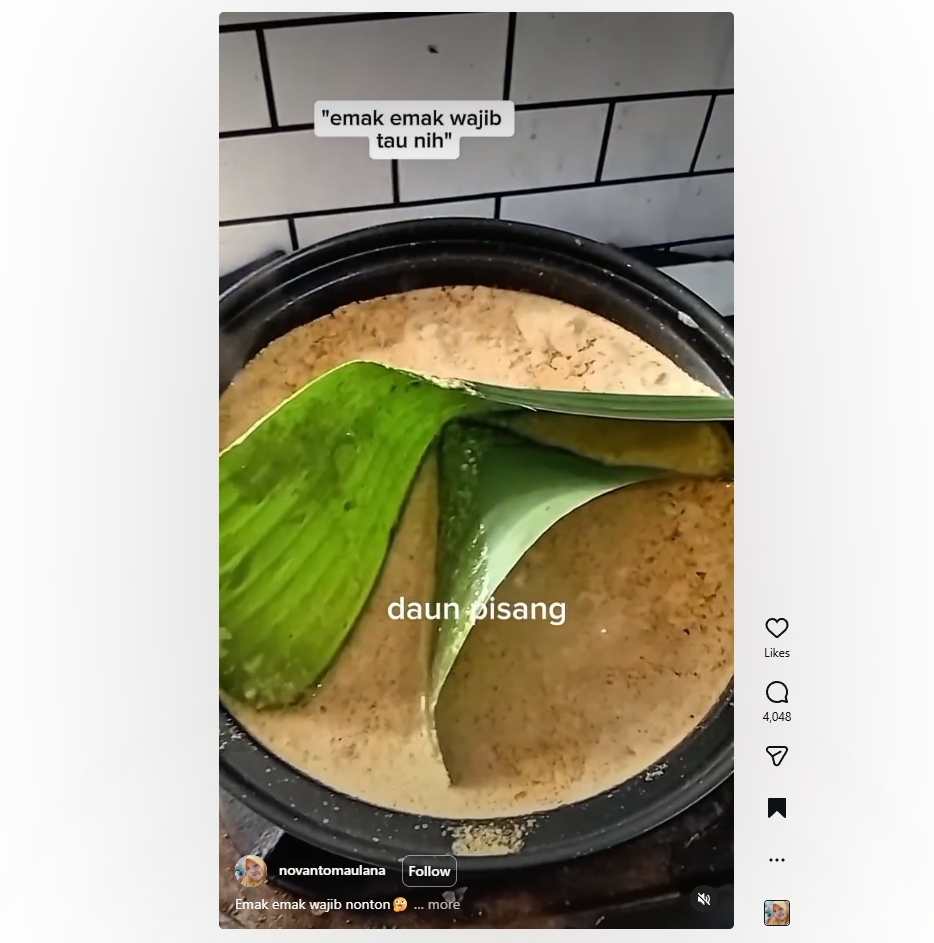
photo: Instagram/@novantomaulana
3. Stir gently over low heat while occasionally pressing the banana leaves to help combine the coconut milk.
4. Leave it for a few minutes until the texture of the coconut milk becomes smoother and creamier.
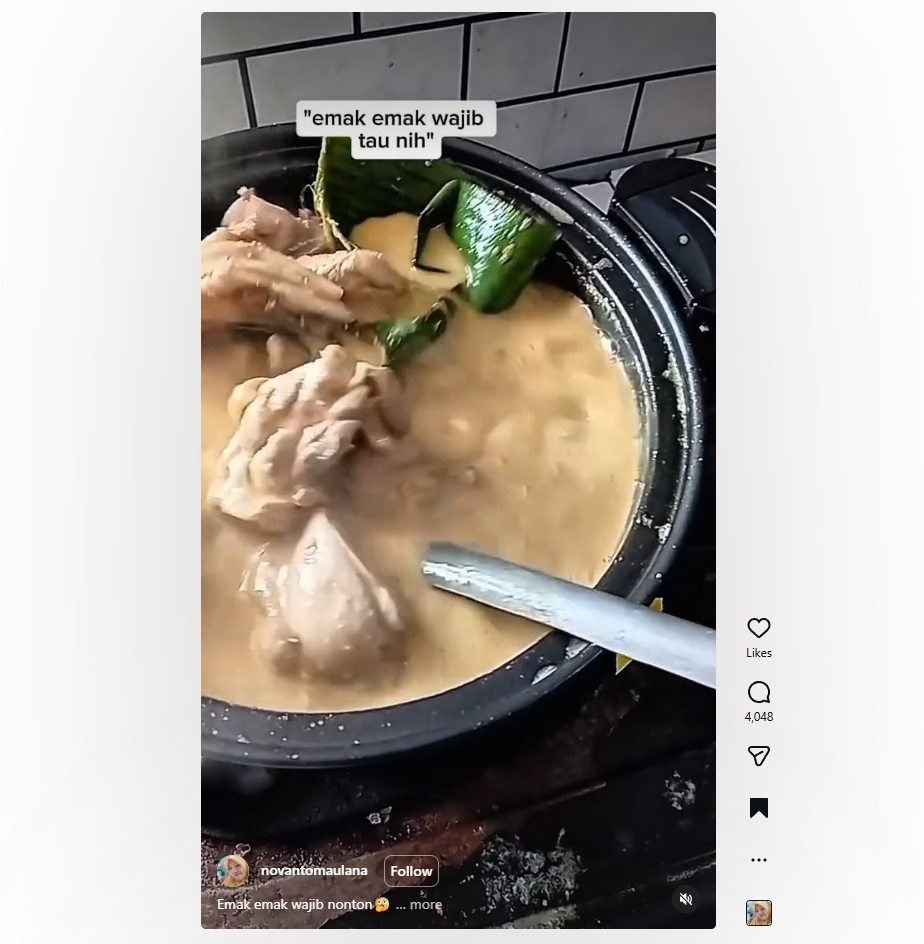
photo: Instagram/@novantomaulana
5. Remove the banana leaves before serving.
Tips so that coconut milk doesn’t break easily
– Use low to medium heat when cooking coconut milk.
– Stir the coconut milk slowly and consistently.
– Add coconut milk at the final stage of cooking if possible.
– Avoid cooking coconut milk for too long.
– Use fresh coconut milk so that the results are more stable and creamy.
General Questions
1. Why does coconut milk break when cooked?
Because the temperature is too high or not stirred enough, the fat and water in the coconut milk separate.
2. Do banana leaves affect the taste of food?
Not significant. Banana leaves only help improve the texture without changing the taste drastically.
3. Apart from banana leaves, are there any other methods?
You can add a little warm water or new coconut milk while stirring gently.
4. Is broken coconut milk still safe to consume?
It’s still safe, only the texture and appearance have changed.
5. Does instant coconut milk break more easily?
Yes, yes, especially if it is not diluted or cooked over high heat.
Author: Anggita Cahya Rosdiana
Bio: Alumni of Communication Science, Muhammadiyah University of Magelang, who has experience in writing published scientific articles, as well as actively writing personal blog articles. Several articles raise the topic of coffee, such as robusta and arabica, as part of an exploration of interest. Currently, he is interested in developing writing on culinary and lifestyle topics, and has an interest in the field of digital communication.
(brl/tin)
PakarPBN
A Private Blog Network (PBN) is a collection of websites that are controlled by a single individual or organization and used primarily to build backlinks to a “money site” in order to influence its ranking in search engines such as Google. The core idea behind a PBN is based on the importance of backlinks in Google’s ranking algorithm. Since Google views backlinks as signals of authority and trust, some website owners attempt to artificially create these signals through a controlled network of sites.
In a typical PBN setup, the owner acquires expired or aged domains that already have existing authority, backlinks, and history. These domains are rebuilt with new content and hosted separately, often using different IP addresses, hosting providers, themes, and ownership details to make them appear unrelated. Within the content published on these sites, links are strategically placed that point to the main website the owner wants to rank higher. By doing this, the owner attempts to pass link equity (also known as “link juice”) from the PBN sites to the target website.
The purpose of a PBN is to give the impression that the target website is naturally earning links from multiple independent sources. If done effectively, this can temporarily improve keyword rankings, increase organic visibility, and drive more traffic from search results.
Comments are closed, but trackbacks and pingbacks are open.